
G-Spot: What the Science Actually Says, and How to Explore It
Where the g-spot is said to sit, why anatomists still disagree about it, how to explore the area without pressure, and what it means if you feel nothing special.
1950Gräfenberg’s paper that later gave the area its name
31Studies reviewed in the 2021 systematic review
62.9%Of surveyed women say they have a g-spot
10,280Nerve fibres in the clitoris, on average
In short
- It is not an organ. No dissection has ever shown a separate structure at that spot, and the 2021 systematic review concludes that its existence as a distinct anatomical entity remains unproved.
- What people feel most likely comes from several tissues working together: the internal roots of the clitoris, the urethra and the front wall of the vagina. Researchers call it the clitourethrovaginal complex.
- An area, not a button. Descriptions place it on the front vaginal wall, a few centimetres inside, with a slightly thicker texture than the tissue around it.
- Feeling nothing in particular is common and signals nothing wrong. For most women, clitoral stimulation is what actually matters.
- Pain is never part of the deal. If exploring stings, burns or hurts, that is a reason to see a clinician, not a sign you need better technique.
You have probably read the promise: find the g-spot in three easy moves, results guaranteed. You try, nothing dramatic happens, and the doubt lands in the same place every time. Is something wrong with me? No. What is wrong is the story we have been told about this area for the past forty years.
Because it is not a switch, and it is not strictly an organ either. It is a name placed on a sensitive region whose existence, as a separate structure, anatomists still argue about. The good news: understanding what is actually going on in the body takes an enormous amount of pressure off.
So let’s take it in order: where the name comes from, what the studies show, where the area sits, and how to explore it without a stopwatch. And if what you really want is a device shaped for that particular angle, our rundown of curved-tip picks will save you from buying blind.
Where the name comes from
The term points back to Ernst Gräfenberg, a German gynaecologist who described, in 1950, the sensitivity of the front vaginal wall along the urethra. Read that carefully: he described a diffuse sensitive region, not a precise target, and certainly not a guarantee of anything.
It was other authors who, in 1982, published a popular book naming the area after his initial. It sold, and something got lost on the way. Gräfenberg described vague territory; popular culture wanted a bullseye. Hence four decades of confusion, and a lot of people convinced they are failing an exam.
Does the g-spot actually exist?
It is the most honest question available, and it deserves two minutes. In 2021, a team of gynaecologists went through the whole body of published evidence in a systematic review in Sexual Medicine: 31 studies, covering surveys, clinical examinations, imaging and tissue analysis.
The findings are fascinating precisely because they contradict each other depending on the method. In surveys, 62.9% of women said they had a g-spot. In clinical studies, an examiner identified one in 55.4% of participants. But once you reach the microscope, consistency collapses: no reliably locatable structure, no nerve bundle specific to the area. The authors conclude that even the studies treating it as real fail to agree on its size, its location or its nature, and that its existence remains unproved.
A 2012 review in The Journal of Sexual Medicine had already landed in the same place: objective measures could not confirm a distinct anatomical entity.
Now avoid the usual misreading. None of this means the sensations millions of people describe are imaginary. It means we were looking for the wrong thing.
The clitourethrovaginal complex
The strongest explanation available today comes from a 2014 paper in Nature Reviews Urology, co-authored by Emmanuele Jannini and Odile Buisson. Their proposal: instead of a hidden organ, there is a functional zone where the clitoris, the urethra and the front vaginal wall interact. They named it the clitourethrovaginal complex.
To follow the logic you have to drop a childhood diagram. The clitoris is not the small visible part: it is a wishbone-shaped organ whose roots run several centimetres down either side of the vaginal canal. And it is densely wired. A 2023 study in The Journal of Sexual Medicine counted the fibres in its dorsal nerves for the first time and found roughly 10,280 on average, well above the 8,000 figure repeated in the media for decades.
Put plainly: you are not hunting for a secret organ. You are looking for an angle, the place where the vaginal wall sits closest to tissue that is already highly sensitive.
Where the area sits, in practice
Descriptions agree on three simple landmarks. The area is on the front wall of the vagina, the belly side rather than the back. It is close to the entrance, usually described somewhere between three and five centimetres in, roughly one to two finger joints. And the surface can feel slightly different from its surroundings: a little thicker, a little more textured.
Two caveats explain most of the failures. First, the position varies from person to person. There is no universal coordinate to memorise. Second, the area is not the same at all times. Arousal fills the surrounding tissue with blood, which is what makes it noticeable at all. Searching when nothing is aroused means searching for something that is not there yet.
Order matters more than technique
Exploring this region achieves very little without real build-up first, and for most people that build-up runs through the external clitoris. If you want to start from the foundations, our piece on how clitoral stimulation actually works is the right place to begin. The g-zone shows up afterwards, not before.
How to find the g-spot without the pressure
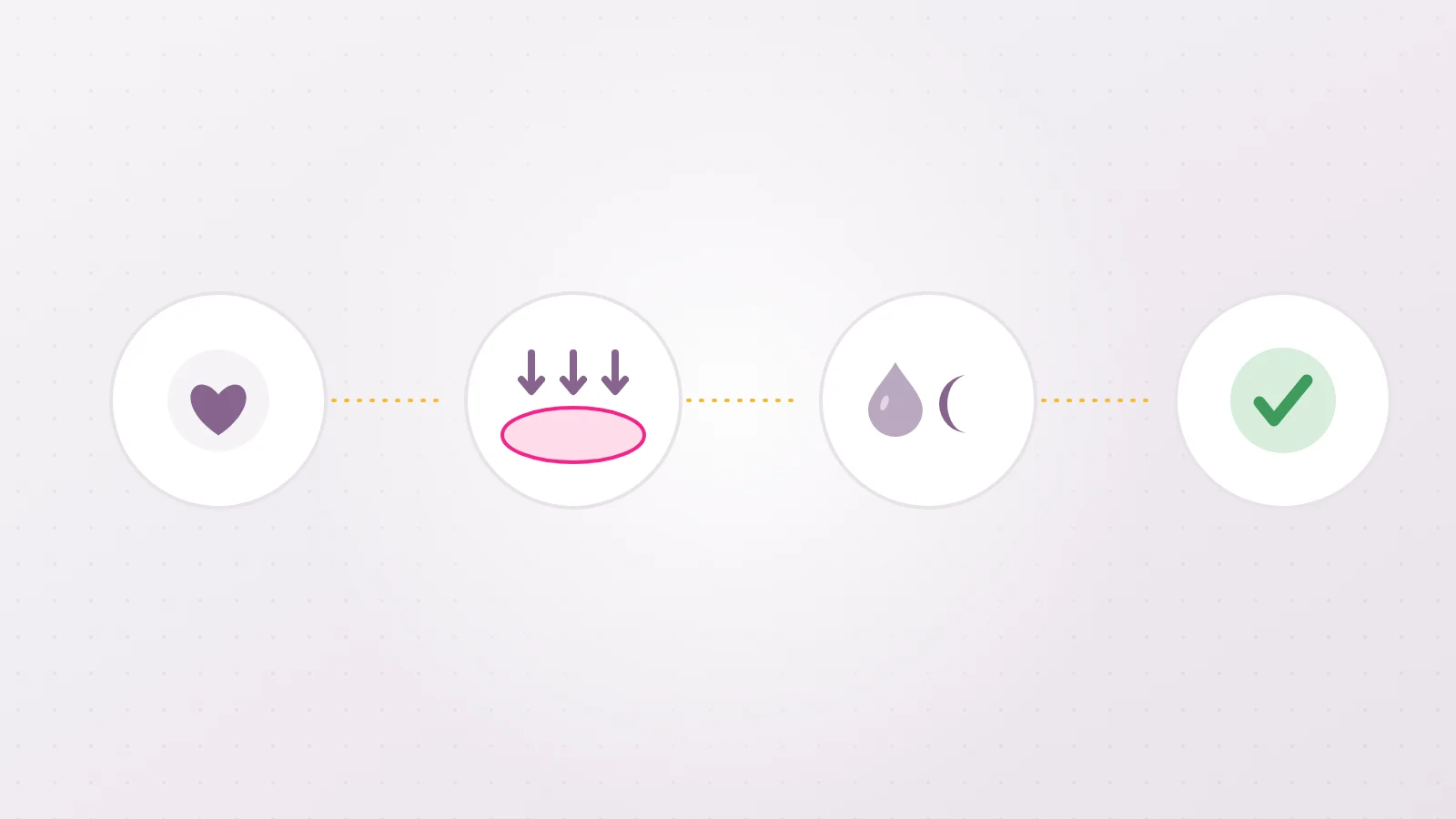
Here is the only honest method: slow exploration, no performance target, clean hands and short nails. Everything else is a matter of paying attention.
Start on your own
It is simpler, and it is fairer. On your own you feel exactly what you touch, you have nobody to reassure and no reaction to manage. Plenty of people map their own sensitive areas this way first, then know how to explain them to a partner. Doing it the other way round rarely works.
Look for pressure, not a spot
This is the key difference. The external clitoris responds to light contact, whereas this region tends to respond to firm, steady pressure directed towards the front of the body. That is exactly why devices made for it are curved rather than straight. Light grazing here will register as nothing at all.
Lubricant, and time
Natural lubrication shifts with your cycle, your age, how tired you are and your contraception. A water-based lubricant removes the friction that otherwise drowns out subtler sensations. As for time, count in weeks rather than evenings. You are learning a map, not passing a test.
Let yourself find nothing
The most useful line in this article: you are under no obligation to succeed. Some people describe a distinct, unmistakable sensation. Others get a brief urge to pee. Others feel a neutral pressure and shrug. All three are normal, because there is no standard organ waiting to be switched on.
“I don’t feel anything”: what that means

That you have a great deal of company. A US survey of a nationally representative sample of 1,055 women aged 18 to 94, published in the Journal of Sex & Marital Therapy, puts the numbers in perspective: 36.6% said clitoral stimulation was necessary for them to reach orgasm during penetration, 18.4% said penetration alone was enough, and around 36% said it was not necessary but that their orgasms felt better with it.
Read those proportions again. Only a minority reach orgasm through penetration alone. That is not a manufacturing defect distributed at random, it is simply the majority anatomy. Treating this one area as the holy grail asks a body to behave like somebody else’s.
There is also a side effect nobody warns you about: the harder you search, the more you step outside your own sensations to watch yourself fail. That shift in attention kills arousal outright. Giving up the goal is, paradoxically, often what makes something happen.
What curved devices are for
They do not perform magic, they solve a geometry problem. Reaching the front wall at the right orientation with steady pressure asks your wrist to hold an awkward position. A curved shaft does that job for you.
Three criteria are enough. Curve first: a clearly angled tip, not a straight tube. Material next: medical-grade silicone, non-porous, genuinely cleanable. Size last, and modest, because the area is close to the entrance and extra length buys you nothing here. If this would be a first purchase, our calm walkthrough for absolute beginners covers the comfort criteria that actually matter.
One clarification worth making: a curved device replaces nothing. Many people firmly prefer the models built for the external clitoris, and that is a preference, not a stepping stone.
When to talk to a clinician
These signs are not technique problems
Pain at the entrance or deeper, burning, bleeding, persistent dryness, painful urination or repeated urinary tract infections are all reasons to get checked, not signs that you are exploring badly. Talk to a health professional: your GP, a gynaecologist, a sexual health clinic or a pelvic floor physiotherapist. These things usually respond well to treatment, and often quickly. This article is information, never a substitute for medical advice.
What to take away
The g-spot is not an organ some people were born without. It is shorthand for a region where several sensitive tissues meet, with geometry specific to each body. Seen that way, there is no exam left to pass: there is a personal map to learn, slowly, in the right order, with or without a device. If that approach suits you, the rest of our guides to understanding your own body start from exactly the same place: understand first, then explore.
Frequently asked questions about the g-spot
Does the g-spot exist scientifically?
Not as a separate anatomical structure. The 2021 systematic review concluded that its existence remains unproved, because studies cannot agree on its size, location or nature. The sensitive area people describe is real, though. Researchers explain it through the clitourethrovaginal complex, where the roots of the clitoris, the urethra and the front vaginal wall interact.
How deep inside is it?
Descriptions place it on the front wall of the vagina, the belly side, around three to five centimetres from the entrance. Treat that as a range rather than a measurement: the position varies between people, and the area only becomes noticeable once arousal has filled the surrounding tissue with blood.
Why do I feel nothing there?
Because that is common and signals nothing wrong. In a large US survey, fewer than one woman in five said penetration alone was enough for orgasm, while more than a third needed clitoral stimulation. There is no standard to meet here, and no reason at all to push through.
Do I need a special device for this area?
No, fingers are enough. A curved-tip device mainly solves a wrist problem: it holds firm, well-aimed pressure without effort. If you do buy one, look for a pronounced curve, medical-grade silicone and a modest size, since the area sits close to the entrance.
Can this make me feel like I need to pee?
Yes, and it makes anatomical sense, because the area runs alongside the urethra. The sensation is harmless and usually passes if you empty your bladder beforehand. If it comes with burning, pain or repeated urinary infections, see a health professional.
Should it hurt?
Never. Firm pressure is not pain, and nothing about this exploration justifies gritting your teeth. Pain on penetration or deeper is a symptom in its own right, with identifiable causes and real treatments. It deserves medical attention rather than patience.