

Edging: What It Really Is, and How to Try It Properly
Edging means building to the edge of orgasm, then easing off. What the practice actually gives you, how to try it without frustration, and what the research shows.
5.4 minmedian time to ejaculation, measured in 500 couples across five countries
35 s to 3.5 mingain after three months of guided stop-start practice (2023 trial)
about 1 minthreshold sexual medicine uses to define lifelong premature ejaculation
2 to 3 %of men affected by that lifelong form under the strict definition
In short
- Edging means building right up to the edge of orgasm, easing off or stopping, then starting again. The name comes from « edge ».
- The most reliable benefit is not stamina. It is learning to recognise your own arousal thresholds.
- Its clinical cousin, the stop-start technique, is the version that has actually been studied, and it takes weeks of regular practice.
- The practice is considered safe. The real risk is frustration, once it turns into homework.
- Ejaculation that is consistently too fast, or impossible, and that bothers you is worth raising with a clinician.
You have probably seen the word thrown around on a forum or in a video, without ever finding a clear explanation. Edging comes up constantly in conversations about stamina and pleasure, almost always wrapped in oversized promises: explosive orgasms, total control, the end of premature ejaculation. What it really offers is smaller and, honestly, more interesting: learning to recognise what happens in your body in the seconds before the point of no return.
Here is what the evidence supports, what rests on personal reports, and how to try it without turning a good evening into a graded exercise.
What edging actually means
The name comes from edge. Edging means deliberately approaching that edge, then dialling the stimulation down or stopping altogether before you tip over. Arousal drops a notch, then you build again. Repeated three or four times, this back and forth stretches out the plateau phase, the stretch where pleasure is already high but nothing is settled yet.
You will also see it called orgasm control, peaking, or surfing. Different words, same idea.
Two things it is not. Edging is not the withdrawal method: it is in no way contraception, and the goal is to delay ejaculation rather than avoid it. It is also not the same as prolonged retention over days or weeks, a practice whose claimed benefits rest on nothing measurable.
What you actually get out of it
A map of your own signals
This is the most concrete benefit and the least glamorous. By stopping on purpose, over and over, you start to notice the signs that come just before the point of no return: breathing speeding up, tension low in the abdomen, the pelvic floor tightening. That internal map underpins any work on timing, and it builds nicely alongside pelvic floor training for men, which teaches you to engage that muscle on demand.
An orgasm described as fuller
Plenty of people report a more intense orgasm after several cycles. Let us be straight about the status of that claim: it rests on consistent personal accounts, not laboratory measurement. No study has compared an orgasm reached directly with one reached after edging. What is well documented is that paying attention to sensation, and lengthening the arousal phase, changes how pleasure is experienced.
One number worth knowing
Before chasing “longer”, it helps to know the baseline. A survey of 500 couples across five countries measured a median time of 5.4 minutes between penetration and ejaculation, with individual values running from 33 seconds to more than 44 minutes. The spread is enormous, and the figures people quote online sit nowhere near the middle of it. Measuring yourself against an imaginary standard is the fastest way to invent a problem.
Some people prefer to control the stimulation by hand, others with a device whose pressure and rhythm they can adjust precisely. If the second route interests you, our guide to choosing a male masturbator breaks down textures and mechanisms, and what matters when you want precision rather than raw intensity.
How to try edging, step by step
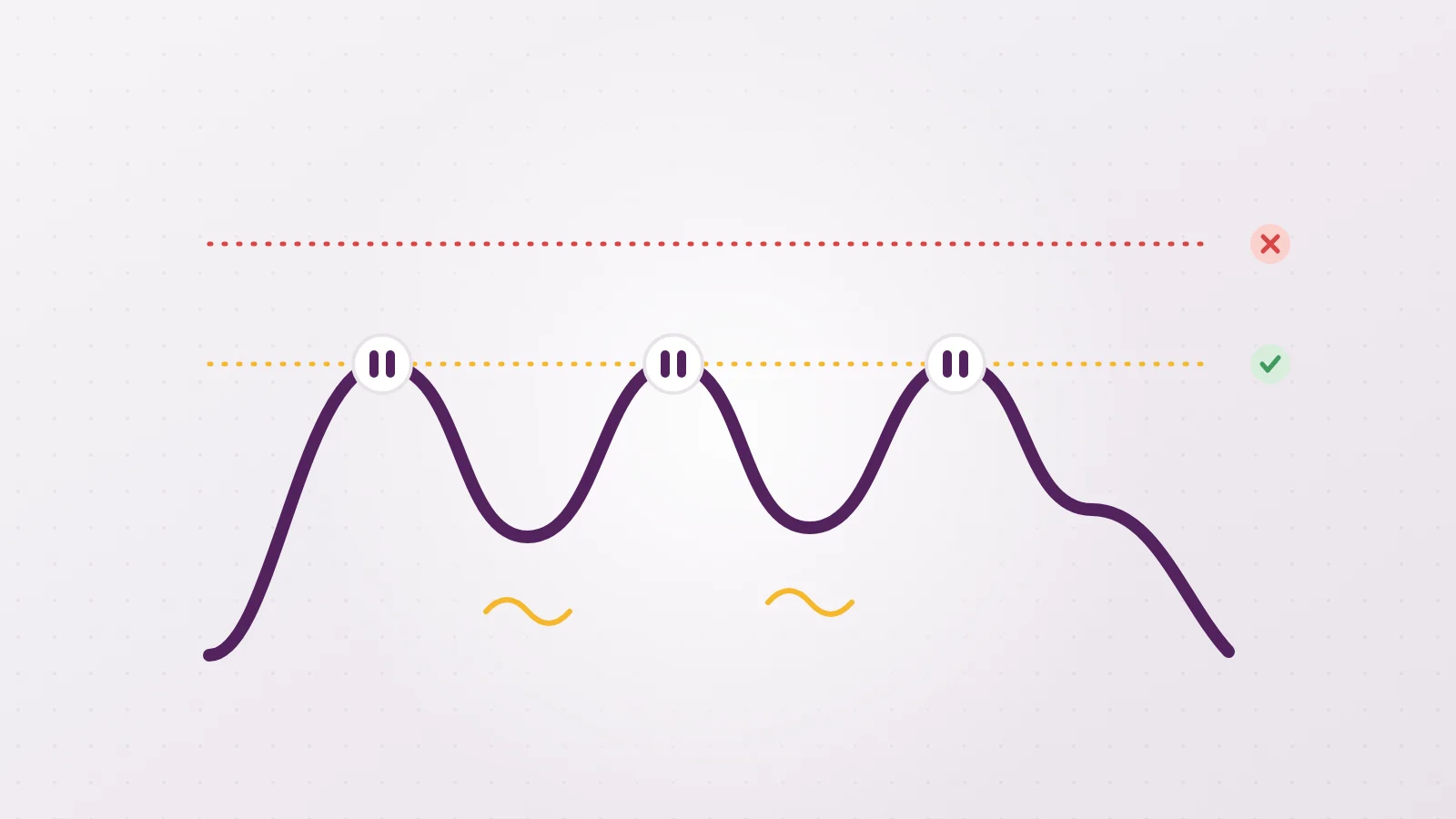
Start on your own. Nobody to reassure, no rhythm to match, and you can stop whenever you like.
- Set yourself a mental scale from 1 to 10. At 1, nothing is happening. At 10, it is over.
- Build calmly to 7 or 8. Not 9: early on, people misjudge it and overshoot.
- Stop completely. Take three or four slow breaths, releasing your thighs, glutes and belly.
- Wait 20 to 30 seconds, long enough for arousal to settle back to 5 or 6.
- Start again, slightly gentler than last time.
- Three or four cycles is plenty. Finish whenever you want, with no obligation to “succeed” at anything.
The detail that makes the difference
Your hand is not the brake, your breath is. A long, low exhale brings arousal down far faster than simply stopping, because it releases the pelvic floor instead of clenching it. And if you overshoot twice in a row, the problem is not the stop: you are climbing too fast. Slow down the phase before it.
With a partner, it is mostly about talking

As a couple, edging only works if both people get something out of it. Otherwise one of you waits while the other watches an internal counter, and the mood evaporates. A few simple anchors:
- Agree a signal in advance, a word or a hand placed somewhere, rather than commentary mid-flow.
- Pauses are not gaps. They are for kissing, touching, changing position. Our advice on intimacy for couples keeps coming back to this idea of slowing down instead of pushing on.
- Positions where the receiving partner sets the pace make stopping much easier to negotiate.
- If one of you is bored, drop the exercise and keep the rest of the evening.
One pattern worth avoiding: solemnly announcing “tonight we are going to try edging” loads the moment with pressure. Easing into it without naming it almost always goes better.
Edging and premature ejaculation: what clinicians say
This is usually the real reason the word gets typed into a search bar, so let us be precise.
The definition used by the International Society for Sexual Medicine describes ejaculation that always or nearly always happens within about one minute, right from the earliest sexual experiences: that is the lifelong form. The acquired form means a clear drop from your usual timing, often to around three minutes or less. Either way, three elements have to be present: a short latency, the sense of not controlling when it happens, and genuine distress for the person or the couple. Under that strict definition, the lifelong form affects roughly 2 to 3 % of men. The feeling of being “too quick” is far more common, and it does not necessarily point to a disorder at all.
What research has examined is not edging as it circulates on social media, but its clinical form: the stop-start technique, described back in the 1950s, and the squeeze technique, firm pressure applied for 10 to 20 seconds just before the tipping point. The NHS still lists both as first-line self-help, while warning that they take a lot of practice before they pay off. It adds other practical options, including thicker condoms and letting the partner on top withdraw as climax approaches.
A trial published in PLOS One in 2023 followed 80 men through six sessions over three months. In the group practising stop-start alone, average latency rose from 35 seconds to roughly 3.5 minutes. In the group that added sphincter control training, it reached close to 9 minutes. Two lessons: these techniques genuinely work, and the results came from a structured, supervised routine rather than a couple of improvised attempts.
When to see a doctor
If ejaculation is consistently very fast, or very hard to reach, or if these exercises bring pain, speak to a clinician: a GP, a urologist or a sex therapist. Medical causes are treatable, whether an infection, a hormonal imbalance or a medication effect, antidepressants being a common one. Proper support beats months of solo drilling. This article is information, not medical advice.
Limits, and myths worth dropping
Overall, edging is considered safe, and the downsides reported are mild and short-lived. A few things still deserve attention.
- Frustration. This is the main risk, and it is psychological. An exercise that becomes an obligation strips out everything that made the activity enjoyable.
- Aching in the testicles after long arousal without release, sometimes called epididymal congestion. It is benign and settles on its own.
- Irritation from prolonged dry stimulation. A suitable lubricant solves it immediately, and our picks for him flag what to check on material compatibility.
- A reflex that drifts. In a minority of people, too much training in holding back eventually makes orgasm hard to reach. If you notice that, ease off straight away.
Two fears come up again and again with no basis: delaying ejaculation does not damage the prostate and does not cause erectile dysfunction. No credible data supports either, and repeating them does more harm than the practice ever could.
Does it work for women?
Edging is not inherently a male practice. Without such a sharply defined point of no return, it simply takes another shape: stretching the plateau, alternating areas and intensities, letting the build last instead of rushing it. Many women report a longer orgasm, sometimes the possibility of several in a row. The principle is unchanged: find where the threshold sits, then play with it rather than against it.
The takeaway
Edging needs no equipment and performs no miracles. It is an attention exercise: you learn where your threshold is, you learn to see it coming, and then you decide what to do with that information. Practised without a performance goal, it tends to make sex slower and more conscious. Turned into a test, it does the opposite. Start with one session a week, no stopwatch, and listen to what your body tells you.
What does edging actually mean?
The word comes from « edge ». Edging means deliberately building up to the edge of orgasm, then easing off or stopping before you tip over, then starting again. It is also called orgasm control or peaking. Nothing is withheld permanently: the point is to delay, not to avoid.
How many cycles should one session have?
Three or four stops is plenty, especially at first. Beyond that the returns drop off and frustration takes over. A short, attentive session beats a long one spent watching your own threshold.
Does edging cure premature ejaculation?
Not on its own. What has actually been studied is its clinical cousin, the stop-start technique, sometimes combined with the squeeze technique or pelvic floor training. Those work, but only with a structured routine over weeks. If the issue bothers you, a GP, urologist or sex therapist will help far more than an online exercise.
How long before anything changes?
In the 2023 trial on stop-start, improvement was measured after three months of guided practice: one 45 minute session every two weeks with a clinician, plus homework. Think in weeks, not days.
Is it harmful to stop without finishing?
No. Mild, temporary aching in the testicles after prolonged arousal can happen. It is benign and resolves on its own. Delaying ejaculation does not damage the prostate and does not cause erectile dysfunction: no credible data supports either claim.
Can women practise edging?
Yes, and many already do without naming it. Because the point of no return is less sharply defined, the practice is mostly about stretching the plateau phase by varying areas and intensity. The reported payoff is a longer orgasm, sometimes several in a row.